The Strange Career of Jim Crow by C. Vann Woodward
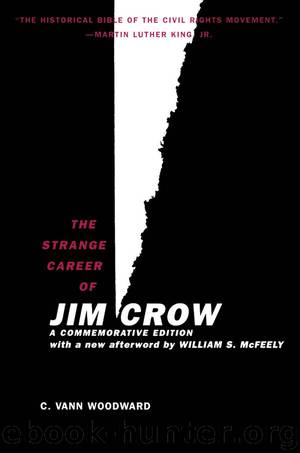
Author:C. Vann Woodward [Woodward, C. Vann]
Language: eng
Format: epub
Publisher: Oxford University Press
Published: 2002-02-28T08:00:00+00:00
3
For almost a century now historians have disputed the decisive factors that led to the first era of emancipation and Reconstruction. To some it has seemed that ideas and their propagation and dissemination have been the important influences. Such historians have naturally stressed the roles of the agitator, the propagandist, and the pressure group. They have dwelt at length upon the abolitionist crusade and the various anti-slavery leaders—their societies, tactics, and the influence these have had upon the course of events. Other writers have deprecated the importance of such influences and have instead laid greater stress upon impersonal, amoral, and non-volitional forces of history. Such people have emphasized the part played by conflicting commercial, industrial, and financial interests of large groups, the blind surges of mass emotions, the exigencies of party politics, and the harsh expedients of modern warfare. No really capable historian has entirely neglected any of these forces, and the better of them have attempted syntheses of all. But they have so far not arrived at a consensus that has met with anything approaching general endorsement.
All the various forces, moral and amoral, whose importance the historians have disputed in explaining the first era of emancipation and Reconstruction have their counterparts in the historical background of the movement we are presently attempting to understand. For the modern development also has a background of ideas, propaganda, agitation, and pressure groups as well as a background of conflicting economic interests, power politics, and war. In both the nineteenth-century and the twentieth-century movements, emotional factors of race prejudice and sectional pride, as well as the compulsions of frustration and aggression, have played their parts. It will long be a matter of debate as to the relative importance played by the agitators, foreign and domestic propaganda, the courts, the White House, party politics, two or three wars, postwar prosperity, the seemingly interminable Cold War, or the dubious influence of nationalism and oppressive conformity working in a new direction. It would be foolhardy to attempt, with no more than the foreshortened and distorting perspective we now have, to arrive at anything more than a very tentative assessment of the bewilderingly complex forces involved and the relative importance of the part each has played.
The evaluation of ideas and their agitation is most difficult because of the impossibility of measuring the results. It is clear at least that the Negro himself played a larger role in the new movement for emancipation than he had in the abolitionist crusade that led to the original emancipation. There were strange movements such as those led by Marcus Garvey and ‘Father Divine,’ but the majority of the more intelligent Negro agitators identified themselves with such organizations as the National Association for the Advancement of Colored People. An interracial organization founded in 1909, the N.A.A.C.P. performed effective work in agitating against discrimination and lynching, but gained no mass support or powerful influence for the first decade or more. Between the First and Second World Wars, however, the number of local chapters increased from about fifty to more than ten times that number.
Download
This site does not store any files on its server. We only index and link to content provided by other sites. Please contact the content providers to delete copyright contents if any and email us, we'll remove relevant links or contents immediately.
| Anthropology | Archaeology |
| Philosophy | Politics & Government |
| Social Sciences | Sociology |
| Women's Studies |
Nudge - Improving Decisions about Health, Wealth, and Happiness by Thaler Sunstein(7707)
The Fire Next Time by James Baldwin(5446)
iGen by Jean M. Twenge(5416)
Adulting by Kelly Williams Brown(4574)
The Sports Rules Book by Human Kinetics(4386)
The Hacking of the American Mind by Robert H. Lustig(4383)
The Ethical Slut by Janet W. Hardy(4253)
Captivate by Vanessa Van Edwards(3839)
Mummy Knew by Lisa James(3691)
In a Sunburned Country by Bill Bryson(3542)
The Worm at the Core by Sheldon Solomon(3487)
Ants Among Elephants by Sujatha Gidla(3467)
The 48 laws of power by Robert Greene & Joost Elffers(3291)
Suicide: A Study in Sociology by Emile Durkheim(3022)
The Slow Fix: Solve Problems, Work Smarter, and Live Better In a World Addicted to Speed by Carl Honore(3009)
The Tipping Point by Malcolm Gladwell(2922)
Humans of New York by Brandon Stanton(2873)
Get What's Yours for Medicare: Maximize Your Coverage, Minimize Your Costs by Philip Moeller(2732)
Handbook of Forensic Sociology and Psychology by Stephen J. Morewitz & Mark L. Goldstein(2705)
